

Our Services
Ground Vibration Testing
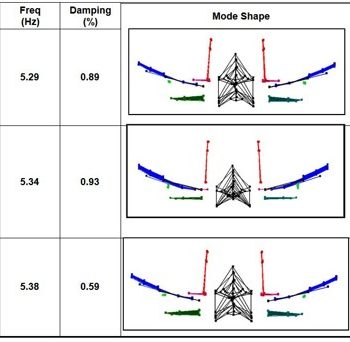
(GVT) is a major milestone in the aircraft and store certification process. The main purpose of the test is to obtain experimental vibration data for the aircraft structure including store configurations so you can validate, i.e.validating 3D Finite Element Models with experimental data, and improve the structural dynamic models. Among other things, these models are used to predict flutter behavior and plan safety critical flight tests.
The data collected during the GVT forms the basis for :
1.Reliable information about the structural behavior in flight.
2.Inspection/ improvement of the mathematical computer model for the aerodynamics, and
3. Flutter analysis
We have partnership with industry leaders in carrying out this process in the most scientific and efficient way using state-of the-art hardware and software.
Related Topic
Finite Element Analysis
Finite Element (FE) Analysis is the most prominent method used to design and analyze structural parts. FE modeling is the data pre-processing for FE Analysis. The calculation accuracy of the FE method depends on the degree of approximation of physical characteristics of the model and its real structure. Therefore, establishing a correct and reasonable FE model is the most important issue to carry out FE analysis and optimization.
The Geometric model is generated by an appropriate 3D design software (such as CATIA) manually during the design process.
This model is then imported into the FE Analysis software.
Meshing and property loading are usually completed via manual software operations.
The full–scaled finite element model includes all main structure members in order to accurately calculate the internal load. In addition, when modeling each member, it is more focused on accurately reflecting stiffness of structure
that has impact on internal load distribution than reflecting the actual structure configuration in detail.
Once an FEA model is established and has been found useful in predicting real-life properties, it may generate the understanding and intuition to significantly improve a design and operation of a device or process. At this stage, optimization methods and automatic control may provide the last degree of improvements that can be difficult to obtain with intuition only. Most modern FEA software features methods for describing automatic control and incorporating such descriptions in mathematical and numerical models. Optimization methods are usually included in the solution process.

Needless to say that as most operations of FE modeling are interactive, design quality and results rely heavily on technical level and experience of designers.
Our experts can help improve the quality of FE Analysis done by your engineers and/or validate the same.
Related Topic
Flutter Prediction & Testing
Flutter test is an important load test during the test phase of each new aircraft or a new store configuration. This type of testing is first performed as a Ground Vibration Test (GVT) for prediction, and for subsequent validation, in flight as a Flutter Test. Flutter testing provides proof of structural strength and stability against fluttering of the aircraft and is an important prerequisite for its certified airworthiness.
Flutter is a self-excited vibration of the wing of an aircraft around which air is flowing. It is caused by an interplay of aerodynamics and elastic forces as well as by inertial forces. Flutter in aircraft causes the wings, stabilizers or control surfaces to oscillate. When the airspeed increases the energy added in each oscillation to the structure by the aerodynamic forces increases. At some speed the damping of the structure may be insufficient to absorb the energy increase from the aerodynamic loads and the amplitude of the harmonic oscillations will grow until the structure breaks. Because flutter always occurs above a certain speed, this limit speed serves to determine the safe operating range.
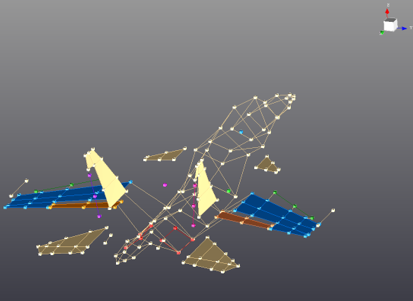
For the test, the aircraft is instrumented with a number of accelerometers. The excitation (to cause the aircraft structure to vibrate in order to determine the aero-elastic stability) are either initiated with installed electrodynamic shakers/actuators or self excited (random) by aerodynamic forces due to the flight conditions and aircraft manouvres. The accelerometers measure the dynamic behavior of the structure. To simulate various load conditions that can occur in different flight situations, numerous defined test setups are tested.
Flutter testing can be broken into three segments: real-time; near real-time and offline. In-flight real-time test campaigns are used to acquire live data during the test flight, mostly as a safety check to continue the flight envelope. The near real-time testing focuses on rapid modal estimation to determine the overall safety of the flight and the flutter test program. The offline testing deals with the finer analysis of the recorded flight data and final report production.
In flight flutter testing of modern aircraft, it is very important to be able to lean on results of pre-flight flutter predictions , to reduce the danger inherent in this type of testing.